
𝐵𝑦 𝐽.𝑀 𝑀𝑎𝑛𝑔𝑎𝑗𝑖
A C-section (or cesarean birth) is a surgical procedure used to deliver a baby when a vaginal delivery can’t be done safely. A c-section can be planned ahead of time or performed in an emergency. It carries more risk than a vaginal delivery, with a slightly longer recovery period rate during labor. Your obstetrician might decide that the baby can no longer tolerate labor and that a C-section is necessary.
How common are C-sections?
According to the Centers for Disease Control (CDC), C-sections account for about 30% of all deliveries in the United States.
What can I expect before a C-section?
If you have a planned C-section, the following procedures will take place:
You’ll sign consent forms for the procedure.
The anesthesiologist will discuss options for anesthesia. Most often, it’s an epidural (or spinal block) that numbs you from your breasts down to your feet.
The hair in the area around the incision will be clipped or shaved.
A catheter will be inserted to keep your bladder empty.
You will have heart and blood pressure monitors applied.
You’ll get an IV in your hand or arm to give you medicine and fluid.
You’ll discuss the procedure and what to expect with your obstetrician (if you haven’t already).
If you need an emergency C-section, your obstetrician delivers your baby quickly because either the health of you or your baby is at risk. However, there’s typically not much time to prepare, and you may need general anesthesia because it works faster.
What actually happens during a C-section?
The first step in a C-section procedure is preparing you for anesthesia. Most planned C-sections use an epidural, so you are awake for the delivery. However, in some cases, you’re asleep under general anesthesia.
Your abdomen will be cleaned with an antiseptic, and you might have an oxygen mask placed over your mouth and nose to increase oxygen to your baby. Next, your provider places a sterile drape around the incision site and over your legs and chest. Finally, your providers raise a sterile curtain or drape between your head and your lower body.
The obstetrician will then make an incision through your skin and into the wall of your abdomen. They might use either a vertical or transverse incision. A horizontal incision is also called a bikini incision.
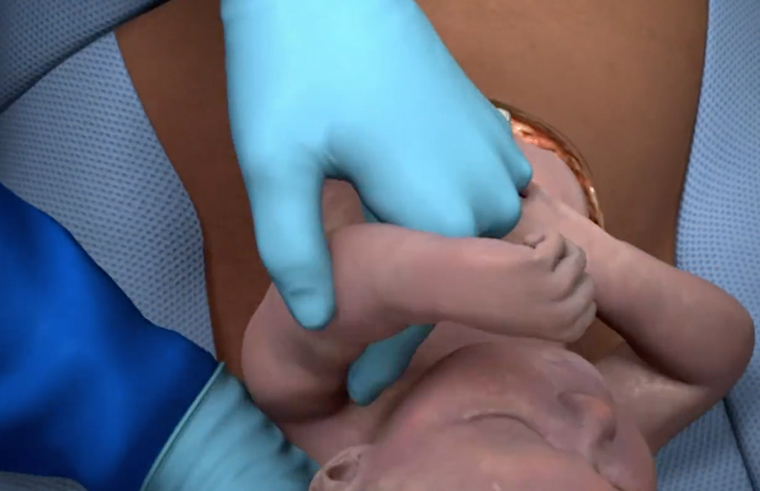
Next, your provider cuts a 3- to 4-inch incision into the wall of your uterus. This incision can also be transverse or vertical. Finally, the obstetrician removes your baby through the incisions. The umbilical cord is cut, the placenta is removed and the incisions are closed with stitches and staples.
Emergency C-sections follow the same steps; however, the speed at which your baby is removed is different. During a planned C-section, the delivery takes about 10 to 15 minutes. Your provider removes your baby in only a few minutes in an emergency C-section.
If you’re awake for your C-section surgery, you will be able to see and hold your baby shortly after it’s born.
What does a C-section feel like?
You’ll be under anesthesia, which should prevent you from feeling any pain. Most people report feeling a tug or pull when their baby is removed from their abdomen.
Are C-sections safe?
Vaginal births are usually preferred, but in some cases, a C-section is the only safe option. For example, a C-section is the safer option when your baby is breech or you have placenta previa (placenta covers part of the cervix). A C-section carries risks and benefits, which should be discussed with your pregnancy care provider.
How long does a C-section surgery take?
The typical C-section takes about 45 minutes from start to finish. After your provider delivers your baby, they’ll stitch your uterus and close the incision in your abdomen. Different types of emergencies can arise during a delivery. In some cases, the delivery will happen very quickly, with your baby being delivered in as little as 15 minutes. This is an emergency C-section.
What happens after a C-section?
Like vaginal births, your obstetrician will deliver the placenta after your baby is born. Next, your provider will stitch your uterus and stitch or staple your abdominal muscles. Stitches should dissolve, but staples are removed at the hospital about one week later. Your abdomen will be sore for several days or weeks. In some cases, your provider may prescribe stronger pain medication.
You can expect to limit your activities, take it easy and rely on family and friends once you go home. A typical C-section surgery requires at least two to three days in the hospital.
How long does a C-section recovery take?
Once the anesthesia wears off, you’ll begin to feel the pain from the incisions. You might also experience gas pains and have trouble taking deep breaths. Make sure an adult is there to help you get up from bed the first several days following C-section surgery. Most people stay in the hospital between two and three days.
A full recovery can take between four and six weeks. Ask your healthcare provider what you can expect during recovery. Most providers recommend avoiding steps, lifting, exercise and other strenuous activities for several weeks. Ask your friends or partner for help with errands, cooking and cleaning so you can rest and recover. Your provider may put restrictions on driving until you’re able to turn your body and apply pressure to the pedals with ease.
You can expect cramping and bleeding for up to six weeks, as well as some discomfort around the incision. Taking over-the-counter pain relievers such as acetaminophen or ibuprofen for pain may help. Avoid sex for at least six weeks or until your healthcare provider gives you the OK.
You will also have a vaginal discharge after the surgery due to the shedding of your uterine lining. The discharge, called lochia, will be red at first and then gradually change to yellow. Be sure to call your healthcare provider if you experience heavy bleeding or a foul odor from the vaginal discharge. Use sanitary pads, not tampons, until you’re completely done bleeding.
Can I have a baby vaginally after a C-section?
The majority of people who had a C-section can consider a vaginal delivery in future pregnancies. If you meet the following criteria, your chances of vaginal birth after cesarean (VBAC) are significantly increased:
Your provider used a low transverse incision.
Your pelvis is not too small to accommodate an average-sized baby.
You’re not expecting multiples.
Your first C-section was only performed because your baby was breech.
What is more painful: a C-section or natural birth?
The level of pain you experience during childbirth is unique. For example, if you opt for an unmedicated vaginal birth, you can expect more pain than someone who had an epidural before a vaginal birth. During a C-section delivery, you won’t feel much pain. However, recovering from a C-section may be more painful and take longer than recovering from a natural birth. There isn’t a right or wrong answer as to what is more painful because every birth is different.
How many C-sections can you have?
The number of C-sections you can have is unique to your medical history and pregnancy. An exact number hasn’t been agreed on. The surgery may be slightly more complicated each time due to prior incisions or scarring.

 𝗧𝗛𝗘 𝗝&𝗠 𝗛𝗘𝗔𝗟H𝗧𝗛𝗖𝗔𝗥𝗘 𝗖𝗟𝗜𝗡𝗜𝗖𝗦